

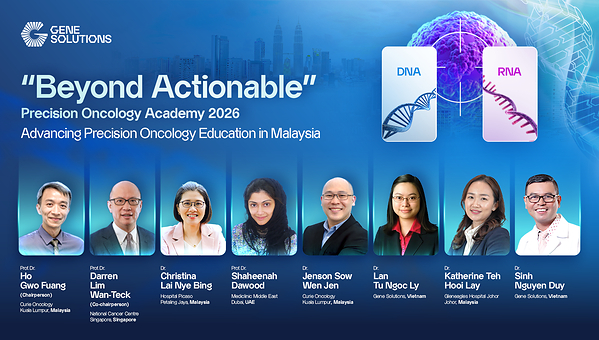
Gene Solutions Malaysia hosted the Precision Oncology Academy 2026 on 25 July 2026 at the Sheraton Petaling Jaya Hotel under the theme ''Beyond Actionable''. An extension of the international K-CONNECT Platform and the recent K-CONNECT Summit 2026 in Vietnam, the Academy brought together oncology experts from the United Arab Emirates, Singapore, Malaysia, US and Vietnam.
The Academy's expert faculty was led by Chairperson Prof. Dr. Ho Gwo Fuang of Curie Oncology, Malaysia, and Co-chairperson Prof. Dr. Darren Lim Wan-Teck of the National Cancer Centre Singapore. They were joined by Prof. Dr. Shaheenah Dawood of Mediclinic Middle East, UAE; Dr. Christina Lai Nye Bing of Hospital Picaso, Malaysia; Dr. Katherine Teh Hooi Lay of Gleneagles Hospital Johor, Malaysia; Dr. Jenson Sow Wen Jen of Curie Oncology, Malaysia; Dr. Sinh Nguyen Duy and Dr. Lan Tu Ngoc Ly of Gene Solutions. Together, the faculty brought expertise spanning clinical oncology, cancer genomics, molecular diagnostics and genomic data interpretation, creating a multidisciplinary forum for translating complex molecular insights into practical clinical decisions.
The Academy examined how large genomic and transcriptomic panels comprehensive profiling can provide a broader view of tumour biology. This includes comprehensive multi-omic approaches such as K-4CARE, which combines tissue-based DNA and RNA profiling with liquid biopsy circulating tumour DNA (ctDNA) analysis for both molecular profiling and ongoing monitoring. DNA profiling may identify genomic alterations associated with cancer growth and reveal biomarkers linked to targeted therapies, immunotherapies or clinical trials. RNA analysis can detect clinically important gene fusions and splice variants that may be missed or remain unclear through DNA-only testing.
The discussions highlighted the complementary roles of tissue and liquid (plasma) next-generation sequencing. While tissue testing remains essential for initial diagnosis and detailed characterisation, liquid biopsy can capture a wider view of tumour heterogeneity and resistance, particularly at progression. Used together, the two approaches offer clinicians a more complete molecular picture to guide treatment decisions.